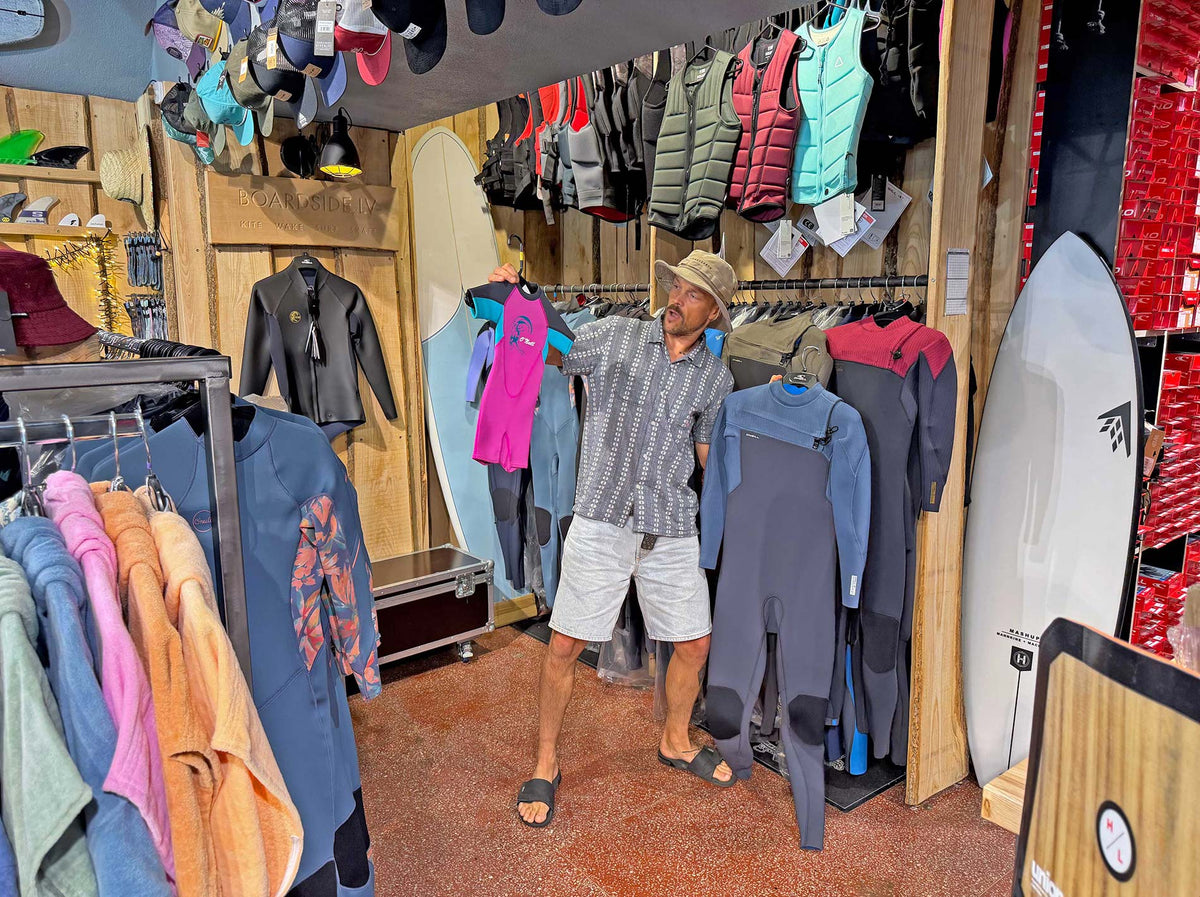
Which wetsuit should you choose for summer? What do 3/2 mm and 5/4 mm actually mean? Why does one wetsuit cost €100 while another costs over €400? And are you really supposed to get wet inside a wetsuit?
Here in Northern Europe, watersports are hard to imagine without a proper wetsuit. A good wetsuit allows you to stay in the water longer, remain comfortable in colder conditions and extend your season from just a few summer months to almost the entire year.
Modern wetsuits come in a wide variety of thicknesses, cuts, constructions and price ranges. For beginners, navigating all these options can be a little overwhelming. That's why we've put together this guide — to explain what really matters when choosing your first, or next, wetsuit.
Expert advice from Dāvis Drande, founder of Boardside.lv and lifelong watersports enthusiast.

How Does a Wetsuit Actually Work?
Let's start with the most important thing: a wetsuit doesn't generate heat. Its job is to help your body retain the heat it naturally produces. Water draws heat away from the human body much faster than air. That's why even on a seemingly warm summer day, spending an extended period in the water can leave you surprisingly cold.
A wetsuit slows down this process. Its main material is neoprene — a flexible insulating material containing tiny closed gas cells that help reduce heat loss.
A traditional neoprene wetsuit isn't completely waterproof. A small amount of water will enter the suit. When it fits correctly, this water forms a thin layer between your skin and the neoprene, where it is warmed by your body. The neoprene itself provides the main thermal insulation, reducing heat loss to the surrounding water. It's important to understand that a wetsuit doesn't become warmer by trapping more water. Quite the opposite: the less cold water continuously enters and escapes the suit, the better it retains heat.
This constant exchange of water is known as flushing, and minimising it is one of the key functions of a well-designed wetsuit. That's why choosing the correct size and fit is just as important as selecting the right neoprene thickness.
Wetsuits vs Drysuits — What's the Difference?
Neoprene Wetsuits
Neoprene wetsuits are the most popular choice for surfing, wakeboarding, kitesurfing, windsurfing, stand-up paddleboarding and many other active watersports. They help retain body heat while providing the flexibility and freedom of movement needed for demanding activities.
A neoprene wetsuit isn't completely waterproof, so a small amount of water entering the suit is perfectly normal. Modern neoprene technology has advanced so much that even relatively thin wetsuits can provide impressive thermal insulation.
Drysuits
Unlike traditional neoprene wetsuits, drysuits are designed to prevent water from reaching your body. They feature watertight seals around the neck and wrists, along with waterproof zips. Most drysuits rely on insulating clothing worn underneath to keep you warm.
Drysuits are still widely used in diving, sailing, kayaking and other activities, particularly in cold conditions. They certainly haven't become obsolete — they simply serve a different purpose.
For active surfing and wakeboarding, flexible, close-fitting neoprene wetsuits are generally the preferred option.
Back Zip, Chest Zip or Zipless — Which Entry System Should You Choose?

One of the first differences you'll notice when comparing wetsuits is the zip configuration. This isn't just a design detail. The entry system affects how easily you can get in and out of your wetsuit, how much water enters and how freely you can move.
Back Zip — The Classic Entry System
The traditional option, and generally the easiest for beginners to understand. A long zip running down the back allows the suit to open relatively wide, making it easier to get in and out.
Back Zip wetsuits are particularly popular for wakeboarding, SUP, waterskiing and recreational watersports. Their biggest advantage is convenience and ease of use.
The downside is that the zip construction can slightly restrict flexibility across the back and may allow more water to enter compared with a well-designed Chest Zip system.
Chest Zip — A More Performance-Oriented Design
A sportier construction, particularly popular among surfers. Chest Zip wetsuits have a relatively small entry opening at the top of the suit. Getting into one may seem complicated at first, but once you've learned a few simple tricks, the process becomes second nature.
The Chest Zip design generally reduces water flushing around the neck and allows greater flexibility across the back. This is especially important in surfing, where you spend a considerable amount of time lying on your board and paddling.
Zipless — Maximum Freedom of Movement
You could call this the most performance-focused entry system. Zipless wetsuits have no traditional zip. Instead, you enter through a specially designed flexible opening that closes securely around the upper body.
By eliminating rigid zip components, this construction allows for excellent freedom of movement. Zipless designs are particularly effective in high-performance wetsuits, especially thinner models made from exceptionally flexible neoprene.
They're often favoured by experienced surfers who want maximum mobility and minimal restriction. Just keep in mind that getting into a Zipless wetsuit requires a little technique — and occasionally some patience!
Wetsuit Thickness Explained — What Do 3/2, 4/3 and 5/4 mm Mean?

Neoprene thickness is one of the main factors determining how much thermal insulation a wetsuit provides.
Generally speaking, thicker neoprene offers better insulation, but it can also reduce flexibility. However, modern premium neoprene has become so advanced that a high-quality thicker wetsuit can sometimes feel more comfortable and flexible than a cheap, stiff, thinner model.
Most wetsuits have two or three thickness numbers, such as 3/2, 4/3 or 5/4/3 mm. The first and largest number refers to the neoprene thickness around the core of your body — typically the chest, back and torso. The following numbers indicate thinner neoprene used in the arms, legs or other areas.
Why the difference? Your core needs greater insulation to maintain body temperature, while your arms and legs require more flexibility for unrestricted movement.
0.5–1 mm — Summer Comfort and Extra Protection
Neoprene this thin is most commonly used in separate garments such as jackets, tops, shorts and leggings. It provides light insulation, some protection against wind chill and additional comfort in warmer conditions. An excellent choice for SUP sessions, summer wakeboarding or as an extra layer.
2 mm — For Warm Water
This thickness is particularly popular in short wetsuits, commonly known as shorties or spring suits. They're ideal for warm summer days in Northern Europe and watersports trips to warmer destinations.
And yes, even in Egypt or the Mediterranean, you can start feeling cold after spending several hours in the water! That's why a lightweight wetsuit can be surprisingly useful, even in tropical or subtropical destinations.
Short wetsuits are also commonly used for children's swimming lessons, particularly in cooler swimming pools.
3/2 mm — The Summer Classic
One of the most versatile wetsuit thicknesses for active summer watersports. With 3 mm neoprene around the torso and 2 mm in the arms and legs, it offers an excellent balance between warmth and flexibility. A 3/2 mm wetsuit is a great choice for wakeboarding, waterskiing, SUP, surfing in warmer conditions and other summer activities.
However, remember that the Baltic Sea can be surprisingly cold even in midsummer. Changes in wind direction can sometimes bring cold, deeper water up to the coast — a phenomenon known as coastal upwelling.
4/3 mm — Cooler Water and a Longer Season
An excellent option for anyone who wants to start their watersports season earlier in spring and continue well into autumn. It's also one of the most versatile wetsuit thicknesses for surfing and other watersports in the Baltic Sea. A quality 4/3 mm wetsuit provides a great compromise between thermal insulation and freedom of movement, especially when made from modern, flexible neoprene.
5/4 mm — Serious Cold-Water Protection
Now we're getting into proper cold-water territory. These wetsuits are designed for colder conditions and longer sessions in the water.
They're popular among surfers, kitesurfers and windsurfers who aren't ready to pack away their gear when the first autumn frosts arrive. Depending on the model, these wetsuits may also feature an integrated hood.
In cold conditions, neoprene boots and gloves become essential parts of your equipment.
6 mm and Thicker — Winter Watersports
The thickest wetsuits are designed for very cold conditions. At this point, the complete equipment system becomes especially important: a well-fitted hooded wetsuit, suitable gloves as well as boots and properly sealed seams.
With the right equipment, experienced surfers can continue enjoying the waves through winter. However, water temperature, air temperature, wind conditions, time spent in the water and personal experience all need to be considered. Even the thickest wetsuit doesn't automatically guarantee warmth or safety in extreme winter conditions.
Important: Neoprene thickness is only a starting point. Two wetsuits with identical thickness ratings can differ significantly in warmth, flexibility and comfort. Always consider neoprene quality, seam construction, fit and how long you intend to stay in the water.
How to Choose the Correct Wetsuit Size

There's one golden rule when it comes to wetsuit sizing:
A wetsuit should fit snugly against your body without restricting your movement or breathing.
If your wetsuit is too loose, empty spaces will allow cold water to circulate more freely, causing your body to lose heat faster. On the other hand, a wetsuit that's too small will feel uncomfortable, restrict movement and place excessive stress on the neoprene and seams, potentially shortening its lifespan.
Wetsuits generally come in familiar sizes such as XS, S, M, L and XL. However, many brands also offer additional sizes designed for different body proportions, including:
- MS or LS (Short) — for shorter individuals with broader body proportions.
- MT or LT (Tall) — for taller, slimmer individuals.
Exact sizing codes and proportions vary between manufacturers.
When using a wetsuit size chart, start with your height and weight. For a more accurate fit, also consider your chest and waist measurements. Whenever possible, we strongly recommend trying the wetsuit on before buying.
It should fit closely without large wrinkles or empty spaces, particularly around the lower back, underarms and crotch. A new wetsuit may initially feel unusually tight, but it should never cause pain or seriously restrict your movements.
Full Suit, Shorty or Two-Piece Neoprene?
Wetsuits come in different cuts and styles, not just different thicknesses.
Full Suit (Fullsuit)
— A full-length wetsuit with long sleeves and legs. The most versatile option for Northern European conditions.
Shorty or Spring Suit
— A short wetsuit, usually with short sleeves and legs, designed for warmer water and summer activities.
Long John
— A sleeveless, full-length neoprene suit that provides excellent shoulder mobility.
Two-Piece Neoprene Clothing
— Jackets, trousers, leggings and tops that can be mixed and matched depending on weather and water conditions.
Two-piece systems are particularly practical for SUP, wakeboarding and other activities where you spend a lot of time above the water.
Which Wetsuit Is Best for Your Watersport?

Different watersports place different demands on your equipment.
Stand-Up Paddleboarding (SUP)
SUP is interesting because you can feel both very warm and very cold during the same session. Active paddling generates plenty of body heat, so wearing a thick wetsuit can quickly become uncomfortable.
In warmer weather, neoprene leggings, a lightweight jacket or a Long John wetsuit may be all you need.
However, there's always a chance of falling into the water. In cold conditions, particularly when paddling away from shore, your clothing must provide sufficient protection in the event of an unexpected swim. Depending on the conditions, a suitable drysuit may also be worth considering.
Jet Skiing and Personal Watercraft (PWC)
For recreational riding in warm conditions, lightweight and two-piece neoprene outfits are popular choices. Their biggest advantage is convenience — they're easy to put on, take off and adjust to changing conditions.
However, at higher speeds, wind chill and constant water spray can cool your body remarkably quickly. Riders who start their season in early spring and continue into late autumn will need more substantial thermal protection.
Wakeboarding
Freedom of movement is particularly important in wakeboarding. Most cable wake parks are located on lakes and relatively shallow bodies of water, which often warm up faster than the sea during summer. That's why 2 mm and 3/2 mm wetsuits are so popular among wakeboarders.
Layering is another common approach. Many riders combine a thinner wetsuit with an additional neoprene jacket, windproof outer layer or riding shorts. This allows them to adapt to changing weather conditions while maintaining the flexibility needed for riding.
Kitesurfing and Windsurfing
In these sports, it's not just the water that cools you down — the wind plays a major role too. That's why riders often prefer warmer wetsuits with good wind protection, particularly around the chest and back.
In Northern European conditions, 4/3 mm and 5/4 mm wetsuits can significantly extend the riding season. Minimising water flushing is also important, especially after high-speed crashes and heavy impacts with the water.
Surfing
Surfing places particularly high demands on a wetsuit. You spend a lot of time lying on your board, paddling, waiting for waves and regularly getting submerged. This makes shoulder flexibility, thermal insulation and minimal water flushing especially important.
It's in these conditions that high-quality Chest Zip and Zipless wetsuits really show their advantages. For autumn and winter surfing in the Baltic Sea, thicker wetsuits with hoods, gloves and boots are often essential.
What Should You Wear Under a Wetsuit?
This is one of the most common questions we hear in our shop. In warm conditions, a wetsuit can be worn directly against your skin or over thin swimwear. No additional clothing is necessary.
However, in colder conditions, specialised thermal layers designed for use under wetsuits can provide extra comfort and warmth. It's important to distinguish these from regular everyday thermal underwear. Ordinary thermal clothing isn't necessarily designed for prolonged immersion in water. Cotton garments in particular should be avoided, as they absorb water, become heavy and dry very slowly.
Specialised watersports thermal layers, on the other hand, are made from materials intended for use under neoprene. These may include thin, flexible synthetic fabrics or specially designed thermal fleece materials. Such layers can provide additional insulation, make a wetsuit easier to put on and make changing in cold conditions more comfortable. In some cases, adding a suitable thermal layer can help extend the usable season of your existing wetsuit without immediately upgrading to a thicker model.
Lycra tops, commonly known as rash guards, can also be useful underneath a wetsuit. They help reduce skin irritation and friction, and some riders find that they make getting into a wetsuit easier. However, a regular thin Lycra top provides very little additional thermal insulation.
And as for Grandma's knitted wool jumper? Better save that for after your surf session!
Why Does One Wetsuit Cost €100 While Another Costs €400 or More?

At first glance, two wetsuits can look almost identical. Both are black. Both are 4/3 mm thick. Both appear to do exactly the same job.
But the difference becomes obvious once you start using them.
A wetsuit's price isn't determined by thickness alone. The biggest differences come from the materials, construction, seams and technologies used.
At Boardside, we specialise in O'Neill — one of the most iconic names in the watersports industry. Founded in 1952, the brand traces its roots back to Jack O'Neill, one of the pioneers of the modern surfing wetsuit. Decades of experience have resulted in an extensive range of wetsuits, from straightforward beginner models to highly technical, professional-level equipment.
Entry-Level Wetsuits
More affordable wetsuits are generally made from durable but less flexible neoprene. They feature simpler seam constructions and linings, but that certainly doesn't make them bad wetsuits. Quite the opposite.
If you're looking for a wetsuit for occasional use, wakeboarding, SUP or summer recreation, an entry-level model can be a very sensible and cost-effective choice. In fact, simpler neoprene constructions can often be particularly resistant to everyday wear and tear.
Mid-Range Wetsuits
This is where noticeable improvements in comfort and technical performance begin. The neoprene becomes more flexible, the fit becomes more refined, and features such as thermal linings and improved seam constructions start to appear.
For example, entry-level wetsuits designed for warmer water may use Flatlock Stitching. These seams are durable and comfortable, but the needle passes through the neoprene, allowing water to penetrate more easily.
Wetsuits intended for colder water often use GBS — Glued and Blind Stitched seams. The neoprene panels are glued together before being stitched without the needle passing all the way through the material, significantly reducing water penetration. Some models also feature internal seam taping for additional reinforcement and protection against leaks.
Premium and High-Performance Wetsuits
At the top end of the range, the focus shifts towards maximum performance. O'Neill's premium wetsuits feature advanced neoprene technologies such as TechnoButter. Depending on the specific generation and construction, TechnoButter neoprene offers exceptional stretch, reduced weight and faster drying compared with more traditional materials.
Premium models may also feature advanced thermal linings, sophisticated seam constructions and highly ergonomic panel designs. The result is a wetsuit that can feel noticeably lighter, more comfortable and less restrictive. If you spend several hours in the water every day, these differences become very significant.
There's one important thing to remember, though:
The most expensive wetsuit isn't necessarily the best wetsuit for you.
Highly flexible premium materials can require more careful handling, so the right choice should always depend on how often you ride, what sport you practise and what you actually need — not just the price tag.

How to Put On a Wetsuit Without Losing Your Patience
Let's be fair — a wetsuit isn't exactly the easiest piece of clothing to put on. If your first attempt leaves you feeling like a frustrated child being squeezed into a winter snowsuit, don't worry. We've all been there! A wetsuit is designed to fit tightly, and getting into one requires a little patience and the right technique.
Here are a few practical tips:
- Start with a dry wetsuit whenever possible. Wet neoprene tends to stick to your skin, making the process considerably more difficult.
- Take your time. Pull the wetsuit carefully over your feet and up to your knees, then work it up to your hips before moving on to the upper body.
- Try the plastic bag trick. Placing a thin plastic bag over your foot helps it slide smoothly through the narrow ankle opening. The same trick can work for your hands.
- Use a dedicated wetsuit dressing aid. Special low-friction sleeves make the process easier and reduce unnecessary stress on the material.
- Avoid pulling on seams or digging your fingernails into the neoprene. Putting a wetsuit on and taking it off are among the moments when it experiences the greatest mechanical stress.
Learning the proper technique won't just save your patience — it can also help your wetsuit last significantly longer.
We have also made separate article with video how to put on and of Chest Zip wetsuit. https://boardside.eu/blogs/news/how-to-wear-and-take-off-a-chest-zip-wetsuit
How to Care for Your Wetsuit

A good wetsuit can last for several seasons if you look after it properly. The basic rule is simple:
Rinse your wetsuit thoroughly with clean, cool freshwater after every session.
This helps remove salt, sand and other contaminants. There's no need for complicated cleaning routines after every use.
However, if your wetsuit starts developing an unpleasant smell or becomes visibly dirty, use a cleaning product specifically designed for neoprene. You can soak the wetsuit briefly in water with a diluted wetsuit cleaner, following the manufacturer's instructions, then rinse it thoroughly.
Avoid washing your wetsuit in a washing machine or using regular laundry detergent, bleach or hot water. The mechanical action of a washing machine can damage neoprene, seams and glued panel connections.
Proper Wetsuit Drying and Storage
Always dry your wetsuit in a shaded, well-ventilated area, away from direct sunlight and heat sources. The best method is to fold it over a wide hanger or drying rail at the waist. For faster drying, start with the wetsuit turned inside out, then reverse it once the inside has dried.
If you use your wetsuit frequently, a purpose-built electric wetsuit dryer can be a very useful accessory. Choose a model designed specifically for neoprene, with gentle airflow and temperature control that complies with the wetsuit manufacturer's care recommendations.
Avoid leaving a heavy, wet wetsuit hanging by the shoulders on a narrow hanger for extended periods. Its own weight can stretch and deform the material. Similarly, storing a wetsuit tightly folded or underneath heavy equipment isn't recommended. Prolonged compression can permanently deform the neoprene and reduce its insulating properties.
For long-term storage, make sure your wetsuit is completely dry and kept in a position that doesn't compress the material. If you need to pack it into a bag, loosely rolling the wetsuit is generally preferable to creating multiple tight folds and sharp creases.
A wet wetsuit is less prone to setting dry creases and can be transported loosely in a waterproof bag, bucket or changing tub until you have the opportunity to rinse and dry it properly. Just don't leave it sealed up wet for longer than necessary — trapped moisture can quickly lead to unpleasant odours and bacterial growth.
The Most Important Thing — Choose a Wetsuit That Works for You
A wetsuit is first and foremost a piece of technical sports equipment, not a fashion accessory. That's why choosing the right one is about much more than colour or finding the biggest discount.
Before buying, ask yourself three simple questions:
What watersport will I use it for? What water temperatures and session lengths should I expect? And does the wetsuit actually fit my body properly?
These are the factors that determine whether your wetsuit becomes an essential part of your adventures or just another disappointing purchase.
Boardside — Advice From People Who Actually Spend Their Time on the Water
Watersports aren't just our business. They've been part of our lives since childhood. Over the years, our passion for surfing, wakeboarding and other watersports gradually became our everyday work. That's how Boardside was born — a surfshop built around real experience, a passion for quality equipment and the desire to help others enjoy their time on the water.
Since 2009, we've gained extensive experience in choosing and using watersports equipment, particularly wetsuits. We don't just sell the gear. We use it ourselves — in Latvian lakes, the Baltic Sea and on surf trips around Europe and beyond. That firsthand experience has taught us how big the difference can be between a wetsuit that simply matches your size chart and one that actually feels great in the water.
Our goal isn't to sell you the most expensive wetsuit. Our goal is to help you find the right one.
Whether you're choosing your first wetsuit, unsure about sizing or trying to understand the differences between O'Neill models, we're here to help. Visit our Boardside surfshop at Terēzes Street 1B in Riga, Latvia, where you can get expert advice, compare different wetsuit models and find the best fit for your needs.
Because the best wetsuit isn't the one with the biggest price tag. It's the one that lets you forget about the cold and focus entirely on why you got into the water in the first place.
Boardside — See you on the water!
[ Explore Wetsuits at Boardside.eu ]